


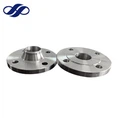

Flange is a part of interconnection between shaft and shaft, used for the connection between pipe ends; also used in the flange on the import and export of equipment, used for the connection between two devices, such as reducer flange. Flange connection or flange joint is a detachable connection consisting of flange, gasket and bolt interconnected as a set of combined sealing structure. The pipe flange refers to the flange used for piping in piping installations, and the flange used on equipment refers to the import and export flange of equipment. There are holes on the flange, and the bolts make the two flanges tightly connected. The flange is sealed with a gasket. Flange is divided into threaded connection (fillet connection) flange, welding flange and clamp flange. Flanges are used in pairs, low-pressure pipelines can use wire connection flange, four kilograms of pressure above the use of welding flange. A gasket is added between the two flanges and then fastened with bolts. The thickness of flanges differs for different pressures, and they use different bolts. Pumps and valves, in connection with the pipeline, the localization of these equipment and equipment, also made corresponding flange shape, also known as flange connection. Where the two planes around the use of bolts to close the connection parts at the same time, generally known as "flange", such as the connection of ventilation ducts, this type of parts can be called "flange parts". But this connection is only a partial equipment, such as the flange and the connection of the pump, it is not good to call the pump "flange parts". Smaller ones, such as valves, can be called "flange class parts".
Classification method
1、According to the chemical industry (HG) industry standards: integral flange (IF), threaded flange (Th), plate flat welding flange (PL), necked butt welding flange (WN), necked flat welding flange (SO), socket welding flange (SW), butt welding ring loose flange (PJ/SE), flat welding ring loose flange (PJ/RJ), lined flange cover (BL(S)), flange cover (BL).
2, according to the petrochemical (SH) industry standards: threaded flange (PT), butt welding flange (WN), flat welding flange (SO), socket welding flange (SW), loose flange (LJ), flange cover (not table note).
3, according to the machinery (JB) industry standards: the whole flange, butt welding flange, plate flat welding flange, butt welding ring plate loose flange, flat welding ring plate loose flange, flanged ring plate loose flange, flange cover.
4, according to the national (GB) standard: the whole flange, threaded flange, butt welding flange, necked flat welding flange, necked socket welding flange, butt welding ring necked loose set flange, plate type flat welding flange, butt welding ring plate type loose set flange, flat welding ring plate type loose set flange, flanged ring plate type loose set flange, flange cover.
Material
WCB (carbon steel), LCB (low temperature carbon steel), LC3 (3.5% nickel steel), WC5 (1.25% chromium 0.5% molybdenum steel), WC9 (2.25% chromium), C5 (5% chromium 0.5% molybdenum), C12 (9% chromium 1% molybdenum), CA6NM (4 (12% chromium steel), CA15 (4) (12% chromium), CF8M (316 stainless steel), CF8C (347 stainless steel), CF8 (304 stainless steel), CF3 (304L stainless steel), CF3M (316L stainless steel), CN7M (alloy steel), M35-1 (Monel), N7M (Hastelloy B), CW6M (Hastelloy C), CY40 (Inconel), etc.
Connection method
Flange (flange) connection is the two pipes, fittings or equipment, each fixed in a flange, between the two flanges, plus flange gasket, bolted together, completed the connection. Some pipe fittings and equipment already comes with a flange, is also a flange connection. Flange connection is an important connection method for pipeline construction. Flange connections are easy to use and can withstand large pressures. In industrial piping, within the home, the pipe diameter is small and it is low pressure and flange connection is not visible. If you are in a boiler room or production site, there are flange-connected pipes and equipment everywhere.
According to the connection method flange connection types can be divided into: plate flat welding flange, necked flat welding flange, necked butt welding flange, socket welding flange, threaded flange, flange cover, necked butt welding ring loose flange, flat welding ring loose flange, ring groove surface flange and flange cover, large diameter flat flange, large diameter high neck flange, eight blind, butt welding ring loose flange, etc .
Welding quality
As the iron plate welding flange, many customers question is the quality of the iron plate welding flange is better than the wrought welding flange. In fact, the quality of iron plate welding flange and forged welding flange quality is the same, but the iron plate welding flange in the end what can not be guaranteed, that is, the iron plate welding flange material is not guaranteed, because the general process, the density of iron plate welding flange is no problem, but in the process of production, the iron plate welding flange blank is rarely tested, so that the production of After coming out, the material of the iron plate welded flange can not be guaranteed without testing.
Welding Process
Required equipment
One set of manual electric welding equipment, one handle type angle grinder, one electric air hammer, one plane ruler.
Preparation before welding
1. Check and debug the equipment to ensure normal operation; 2. Prepare φ4.0J402 welding rod preferably dried at 300℃-350℃ for one hour.
Welding process
1, assembly of the vertebrae and large flange assembled together according to the requirements of the drawings, and then the average large flange into 8 equal parts.
2, welding because the flange is thicker, the bevel is larger, so the use of segmentation symmetry, multi-layer welding.
Weld quality
The strength of the weld is required to reach at least the strength of the base material. Weld surface is smooth, no burn-through, porosity, welding leakage, slag, edge biting, not welded full and other defects. The residual height is less than 2mm.
Caution
1. When priming, be sure to use J506 welding rod manual overlay welding, and use low current welding. Strictly in accordance with the welding process welding.
2、After each welding position, use the level to card the amount of deformation of the flange plane.
3、Welding while hammering the weld with a gas hammer to achieve the effect of stress relief.
Flange gasket
Gasket is a ring made of material that can produce plastic deformation and has a certain strength. Most of the gaskets are cut from non-metallic sheets or made by professional factories according to specified dimensions, and are made of asbestos rubber sheet, asbestos sheet, tetrafluoro sheet, polyethylene sheet, etc.; there are also metal-wrapped gaskets made of thin metal sheets (white iron, stainless steel) wrapped with non-metallic materials such as asbestos; there is also a winding type gasket made of thin steel belt and asbestos belt together, the most common one is stainless steel belt and graphite. The metal-wound gasket is made by winding, and the winding band can also be made of asbestos depending on the usage environment. Common rubber gaskets are suitable for temperature below 120℃; asbestos rubber gaskets are suitable for temperature below 450℃ for water vapor, below 350℃ for oil and below 5MPa for pressure, and for general corrosive media, the most commonly used is acid-resistant asbestos sheet. In high-pressure equipment and pipelines, lenticular or other shaped metal gaskets made of copper, aluminum, 10-gauge steel, or stainless steel are used. The contact width between the high pressure gasket and the sealing surface is very narrow (line contact), and the processing finish of the sealing surface and gasket is high.
Low pressure small diameter has a wire connection flange, high pressure and low pressure large diameter are using welding flange, the thickness of the flange and the diameter and number of connecting bolts are different for different pressure
