


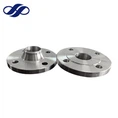

Stainless steel slip-on flanges are a type of flange that is commonly used in piping systems for connecting pipes, valves, and other components. These flanges are made from stainless steel, which is known for its excellent corrosion resistance, strength, and durability.
A slip-on flange has a circular disk with a bored hole that slips over the end of a pipe. The flange is then secured to the pipe with fillet welding, which is a type of welding that creates a continuous, smooth transition between two components. The advantage of slip-on flanges is that they are easy to install and can be used with pipes of different diameters.
Slip-on flanges are available in a variety of sizes and pressure ratings to meet the needs of different piping applications. They are often used in low-pressure applications, such as in plumbing and heating systems, where the pressure on the pipes is relatively low. In high-pressure applications, other types of flanges, such as weld neck flanges or socket weld flanges, may be more appropriate.
When choosing a slip-on flange, it is important to consider the size of the pipe, the pressure rating, and the material grade. Slip-on flanges are available in a variety of material grades, including 304, 316, 317, and 904L. The grade of the flange should be chosen based on the specific application and the operating conditions of the piping system. For example, grade 304 is commonly used in applications where the operating conditions are relatively mild, while grade 904L is used in applications where high corrosion resistance is required.
In addition to the material grade, it is also important to consider the pressure rating of the flange. The pressure rating of a flange is a measure of the maximum pressure that the flange can withstand without leaking or failing. The pressure rating of a flange is determined by the size of the flange, the thickness of the material, and the type of metal used.
When installing slip-on flanges, it is important to follow proper welding procedures to ensure that the flange is securely attached to the pipe. The welding process should be performed by a qualified welder who is experienced in welding stainless steel. The weld should be smooth and continuous, with no cracks or voids, to ensure that the flange is leak-proof.
In conclusion, stainless steel slip-on flanges are a versatile and essential component in piping systems. They are available in different sizes and pressure ratings, and are made from a variety of material grades to meet the needs of different applications. When choosing a slip-on flange, it is important to consider the size of the pipe, the pressure rating, and the material grade to ensure that the flange is suitable for the specific application.
